A calm, clear starting point
Bitcoin, minus
the noise.
A friendly, independent guide to what Bitcoin is, how it works, and what those chart candles actually mean. No hype. No experience required.
15 minutes · Plain language · No account needed
A little more understanding
OPEN KNOWLEDGE · SINCE 2009
One idea at a timeStart here.
01 / 04Live market snapshot · BTC–USD
Bitcoin right now
Data from Coinbase Exchange. Figures are indicative, may be delayed, and can differ between exchanges.
Your fifteen minutes
A short path to
a clearer picture.
Take it in order, or skip to the question you came with. The aim is understanding—not a recommendation.
Meet Bitcoin
What it is, and how it differs from money held in a bank.
Explore the ideaHow it works
A shared ledger, a network of computers, and rules anyone can check.
See the building blocksWallets & keys
Where bitcoin actually lives, and the secret words that control it.
Meet the keysGetting it, safely
How buying works, what it costs beyond the price, and where the traps sit.
Learn the procedureRead the chart
Understand candles, timeframes, volume, and what a chart cannot tell you.
Learn the languageKeep perspective
The risks in plain terms, the key words, and a few grounded next steps.
Finish with context Know the wordsTwo ways in
Keep going, two
different ways.
The lesson above is the trunk. These are the branches: one for learning by doing, one for understanding the story.
Guides · Learn by doing
Start here, stay safe.
The beginner path in the right order, a transaction followed end to end, wallets and buying explained as procedures — and a field guide to spotting scams before they spot you.
Information · Understand the story
History, myths, machinery.
Where Bitcoin came from, which famous claims about it survive checking, how mining really works, what moves the price — and the full glossary in one place.
Learn by playing
Try mining —
the pretend kind.
The ideas on this page, turned into a game: tap to mine, buy rigs, watch the halvings land. Fifteen minutes, same as the lesson.
15-Minute Miner · A simulated game
Fake sats. Real ideas.
Every bitcoin in the game is simulated — no real mining, no real bitcoin, and no wallet needed. What carries over is the shape of the thing itself: the work of mining, the supply shrinking at each halving, a chart that moves whether you are ready or not. It plays right in your browser, free from start to finish, and your progress saves on your own device. Everything in the game's shop is free on this site, too — the skins and extras are simply yours.
Digital money with no central operator.
Bitcoin is an open-source payment network and the digital asset used on it. It lets people send value over the internet without asking a bank or payment company to approve each transfer. The network is maintained by independent computers around the world following a shared set of rules.
Why does that matter to anyone? Because every other kind of digital money you have used sits inside somebody's system, under somebody's rules, and can be frozen, reversed, or refused by the operator. Bitcoin was built to be money that moves the way email moves: directly between people, across borders, at any hour, with the network — not a company — checking the rules. Whether the world needs that is a fair argument. That it works is a fact you can verify from the record itself.
The useful distinctionBitcoin (capital B) is the network and software. bitcoin (lowercase b, often BTC) is the unit recorded on that network.
One public record, checked by many.
Transactions are grouped into blocks and linked in chronological order to form the blockchain. Thousands of computers independently keep and check copies of this public record. No single computer owns the master copy.
Specialized computers called miners compete to add the next block by doing computational work. This proof-of-work process helps order transactions and makes past records costly to alter. The network’s rules—not a central company—determine which blocks are accepted.
Two kinds of computers keep this honest, and it is worth separating them. Nodes are the referees: ordinary machines, run by anyone, that hold a full copy of the record and reject anything that breaks the rules. Miners are the contestants who compete to write the next page. A miner can propose; only the referees can accept. That separation is why no single company, government, or founder can change Bitcoin's rules by decree — the referees would simply ignore the new page.
Think of it like thisA shared notebook where everyone can verify the entries, but no one can quietly rewrite yesterday’s page.
Scarcity is written into the rules.
The protocol limits the total supply to 21 million bitcoin. New bitcoin enters circulation through mining rewards, which reduce roughly every four years in an event called a halving. This is a software rule that participants can verify; it does not guarantee a particular market value.
Bitcoin is divisible: one bitcoin can be split into 100 million satoshis. A wallet stores the keys that let someone authorize transactions. Losing access to those keys can mean losing access to the bitcoin they control, so custody and security matter.
Your bitcoin lives in the record. Your keys live with you.
A wallet does not hold coins the way a pocket holds cash — the bitcoin stays recorded on the blockchain. What a wallet holds is keys: a private key, a secret that proves the bitcoin is yours to spend, and addresses derived from it that you can safely share so people can pay you. When you "send bitcoin," your wallet uses the key to sign the payment, the way a signature authorises a cheque — except the signature is mathematics, and it cannot be forged.
Because a long key is miserable to back up, wallets show it to you once as a seed phrase: 12 or 24 ordinary words that can rebuild the whole wallet. Treat those words as the money itself, because they are. Written on paper and kept somewhere private, they survive lost phones and dead laptops. Typed into a website or photographed, they are gone — and so, usually, is the bitcoin.
The one ruleNobody legitimate will ever ask for your seed phrase. Not a wallet company, not support, not this site. Anyone who asks is taking your money.
How buying works — and where the traps sit.
This site does not recommend buying anything. But understanding should not depend on a sales pitch, so here is the honest shape of it: most people who buy bitcoin do it through an exchange, a business where buyers and sellers meet. A legitimate one will ask for your name and ID (the law requires it), charge fees beyond the headline price, and let you withdraw to your own wallet afterward. That is the whole procedure — account, verify, buy, decide whose keys hold it.
The traps are all shortcuts around that shape. An "exchange" a new online friend recommends, an app installed from a link in a message, an offer to double what you send — each replaces the boring procedure with a performance, and the performance ends the same way. The full scam field guide lives in the Guides section; the short version fits in one line: if it feels urgent, it is lying.
The trap testIf you found it through an ad, a message, or a person you met online — it is not where you buy. Real exchanges are found by your own research, typed in by your own hand.
Some important boundaries.
Bitcoin is not anonymous: addresses are pseudonymous, and transactions are visible on the public ledger. It is not backed by a government or a company, and transactions are generally irreversible once confirmed. It is also not the same thing as every other cryptocurrency.
People use or study Bitcoin for different reasons. Whether it is useful, suitable, or worth anything to a particular person is a separate question—and a personal one.
And the risks, collected in one place: the price can fall a long way, quickly, and has. Payments are final, so a mistake or a scam has no undo button. Keys that are lost take their bitcoin with them, permanently. None of that makes Bitcoin a trick or a treasure — it makes it a thing to understand before it is a thing to own, which is the order this page was built to teach.
A chart is a record, not a forecast
Learn to read the
shape of a move.
Price charts compress a lot of activity into a picture. Candlesticks can help you describe what happened over a chosen interval. They cannot tell you what happens next.
Real BTC–USD candlesticks
Coinbase Exchange historical data · Times shown in UTC
Waiting for Coinbase historical candle data…
Closed higherClosed lowerVolume bars · BTC tradedEach candle summarizes one day. A useful middle ground for seeing a broad daily move.
Open—
High—
Low—
Close—
Latest interval—
Hands-on · Real Coinbase data
Explore the price yourself
Press and drag across the line — or hover, on a computer — to read the price at any moment. Exploring is all it does: the past, at your fingertip.
LIVE PRICE—
Loading price history…
Loading price history…
Bitcoin · BTC–USD · Coinbase Exchange. Historical data describes the past; it does not predict or guarantee future prices.
01 · Timeframe
Each candle covers one interval. Choose 1H and it represents an hour; 1D means a day. A wider timeframe smooths small moves.
02 · Open & close
The candle body spans the opening and closing prices. A rising candle closes above its open; a falling one closes below.
03 · High & low
The thin wicks mark the highest and lowest prices reached during that interval, beyond the open and close.
04 · Volume & trend
Volume bars estimate how much traded in that interval. A trend is a pattern across many candles—not a promise.
Name that shape
The candlestick cheat sheet
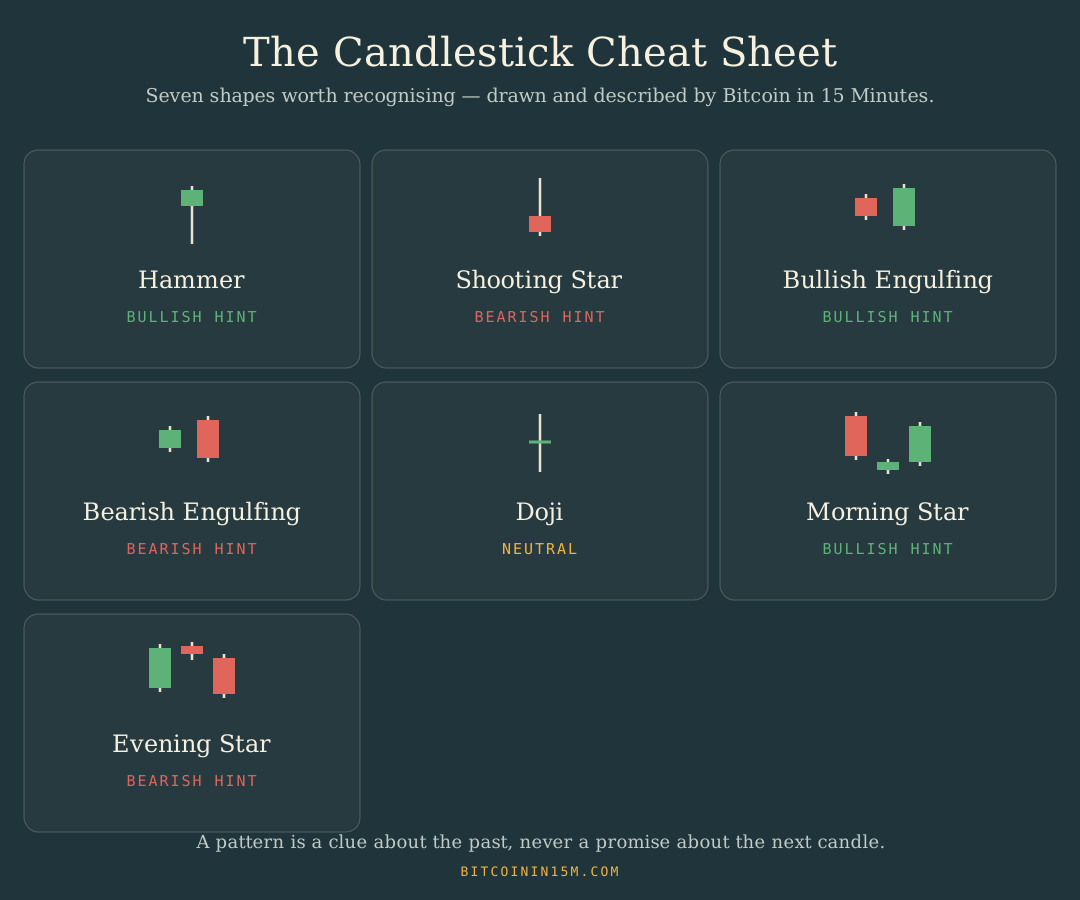
Seven shapes traders have named, drawn and described in our own words. A pattern is a clue about who pushed harder in the past — never a promise about the next candle. Use the sheet to describe what you see, in past tense, and it will serve you honestly.
Hammer
Bullish hintWhat it looks like. A small body perched at the top of a long lower tail, like a hammer hanging by its handle.
How it is usually read. Shows up after a fall: sellers dragged the price down, and buyers dragged most of it back before the period closed. Watched as a sign the fall may be tiring.
Shooting Star
Bearish hintWhat it looks like. A small body sitting at the bottom under a long upper tail — the star shot up and fell back.
How it is usually read. Shows up after a rise: buyers reached for higher prices and got pushed back down. Watched as a sign the climb may be running out of believers.
Bullish Engulfing
Bullish hintWhat it looks like. A modest red candle completely swallowed by the taller green candle that follows it.
How it is usually read. Sellers owned the first period; buyers took the second and then some. Watched as a change of hands — the crowd that was leaving started arriving.
Bearish Engulfing
Bearish hintWhat it looks like. A modest green candle completely swallowed by the taller red candle that follows it.
How it is usually read. The mirror image: buyers owned the first period, sellers took the second outright. Watched as enthusiasm meeting an exit door.
Doji
NeutralWhat it looks like. Open and close finish in almost the same place, so the body shrinks to a line between two wicks.
How it is usually read. A tug-of-war that ended in a draw. On its own a doji reports indecision — it becomes interesting only when it appears after a strong run in either direction.
Morning Star
Bullish hintWhat it looks like. Three candles: a long red one, a small quiet one stranded at the bottom, then a long green one climbing back.
How it is usually read. Named for dawn after a dark night. The small middle candle is the pause where selling ran dry; the third is buyers returning in size.
Evening Star
Bearish hintWhat it looks like. Three candles: a long green one, a small quiet one stranded at the top, then a long red one falling back.
How it is usually read. The morning star at dusk. The pause at the top is buying running dry; the third candle is sellers returning in size.
Save the cheat sheet (SVG image) — one page, all seven patterns, yours to keep.
Historical BTC–USD data from Coinbase Exchange. 1H and 1D candles use exchange intervals; 1W and 1M candles combine daily data into UTC calendar weeks and months. The latest candle may still be forming. Historical movement describes the past and does not predict or guarantee future prices.
12—15 minutes · Context matters
Volatility is part of the picture.
Bitcoin’s market price can move sharply in either direction. A chart makes past movement visible; it does not explain every cause or predict the future. News, liquidity, sentiment, regulation, and many other factors may play a role.
Put plainly, the risks are these: the price can drop sharply and stay down; a payment sent cannot be pulled back; a lost seed phrase cannot be reset; and the loudest voices around Bitcoin are often selling something. None of these is a reason to look away — each is a reason the fifteen minutes you are spending here come before any other step.
A trend is hindsight.A rising or falling pattern describes what a chart has done so far.
Zoom changes the story.A dramatic hourly candle can sit inside a quieter longer-term view.
Past ≠ future.Historical performance does not guarantee future results.
Pause before acting.Learning the vocabulary is not the same as having a plan.
A pocket glossary
Twenty-four terms worth knowing.
Enough vocabulary to follow a basic conversation without pretending the subject is simple.
Address
A string of letters and numbers you share so others can send you bitcoin, similar in spirit to an account number. One wallet can create many addresses, and using a fresh address for each payment makes your activity harder to follow.
Altcoin
Any cryptocurrency other than Bitcoin. Thousands exist, with different rules, risks, and levels of adoption. Bitcoin is not the same thing as every other cryptocurrency, and this site teaches Bitcoin only.
Blockchain
A chronological chain of transaction blocks maintained and checked by the Bitcoin network. Each block points back to the one before it, which is what makes quietly rewriting an old entry so difficult: every later block would no longer fit.
Block
A batch of confirmed transactions added to the blockchain at once, roughly every ten minutes. Each block records the fingerprint of the block before it, forming the chain. The ten-minute pace is a rule of the network, maintained automatically as mining power changes.
Confirmation
A transaction is confirmed when it is included in a block. Each block added after it counts as another confirmation. More confirmations mean a payment is more deeply settled and harder to reverse; many services wait for several before treating a payment as final.
Exchange
A service where people buy and sell bitcoin for national currencies or other assets. Exchanges set their own prices from live supply and demand, which is why the price can differ slightly from one exchange to another at the same moment.
Fiat currency
Money issued by a government, such as the US dollar or the euro. Fiat is not backed by a physical commodity; its value rests on law, custom, and trust in the issuing state. Bitcoin was designed as an alternative that no government issues.
Halving
An event roughly every four years when the reward miners receive for adding a block is cut in half. Halvings are written into Bitcoin's rules and are how the total supply approaches its 21 million limit. A halving does not guarantee any particular price movement.
Hardware wallet
A small physical device that keeps private keys offline and signs transactions without exposing the keys to your computer or phone. It is one common way to hold larger amounts more safely, though the recovery phrase still has to be protected.
Hash
The output of a mathematical function that turns any input into a fixed-length fingerprint. Change even one character of the input and the fingerprint changes completely. Bitcoin uses hashes to link blocks together and as part of the mining puzzle.
Hot wallet
A wallet whose keys live on a device connected to the internet, such as a phone app. Hot wallets are convenient for small amounts and everyday use, but the connection that makes them convenient also makes them easier to attack.
Mempool
The waiting room for transactions that have been broadcast but not yet included in a block. Miners usually pick transactions offering higher fees first, so when the mempool is crowded, a low-fee payment can wait hours or longer to confirm.
Mining
Proof-of-work activity that helps order transactions and add blocks under network rules. Miners spend computing power competing to add the next block; the winner is paid in new bitcoin plus transaction fees, and the work makes past records costly to alter.
Node
A computer running Bitcoin software that keeps a copy of the blockchain and checks every transaction and block against the rules. Anyone can run a node, and the thousands doing so independently are a large part of why no single operator controls the network.
Private key
A secret that proves control over bitcoin. Anyone with it may be able to spend those funds. There is no password reset for a private key: if it is lost, the bitcoin it controls cannot be recovered, and if it is stolen, the bitcoin can be taken.
Proof of work
The system that lets the network agree on which block comes next. Miners must show they spent real computing effort, which makes honest participation profitable and cheating expensive. It is the security backbone that lets strangers trust a shared record.
Public key
The counterpart to a private key. It can be shared openly and is used to create the addresses others pay to. The mathematics is one-way: a public key can be derived from a private key, but a private key cannot be worked out from a public one.
Satoshi
The smallest unit of bitcoin: one hundred-millionth of a bitcoin (0.00000001 BTC). Because bitcoin is divisible this far, nobody needs to buy a whole bitcoin; amounts of a few dollars' worth are ordinary. Named after Bitcoin's creator, Satoshi Nakamoto.
Seed phrase
A list of words, usually 12 or 24, that can regenerate a wallet and everything in it. Whoever has the phrase has the funds, which is why it belongs on paper in a safe place — never in a photo, a note app, or a website.
Transaction
A signed instruction that moves bitcoin from one address to another. Once broadcast, it waits in the mempool until a miner includes it in a block. Confirmed transactions are effectively irreversible, which is why checking the destination address matters so much.
Transaction fee
A small amount paid to miners on top of the amount being sent, chosen by the sender. Fees rise when many people want block space at once and fall when the network is quiet. A fee that is too low can leave a payment waiting.
Volatility
The degree to which a price moves up and down over time. More volatility means wider swings. Bitcoin has historically been far more volatile than major currencies or broad stock indexes, including drops of half its value or more.
Wallet
Software or hardware that manages the keys used to access and authorize bitcoin transactions. A wallet does not contain bitcoin the way a pocket contains coins; the bitcoin stays recorded on the blockchain, and the wallet holds the keys that prove it is yours to spend.
Whitepaper
The nine-page document published in 2008 by Satoshi Nakamoto that proposed Bitcoin: a peer-to-peer electronic cash system. It is short, readable, and still the clearest statement of what Bitcoin was designed to do and why.
The same glossary lives on its own page in the Information section, as a reference to keep open while you read: open the full glossary.
Quick answers
Common Bitcoin questions.
Short, careful answers to the questions people often ask first.
What is Bitcoin in simple terms?
Bitcoin is an open-source payment network and the digital asset used on it. Independent computers follow shared rules to record and check transactions without a central operator.
What does a green or red Bitcoin candle show?
A green candle means the price closed above its opening price for that interval; a red candle means it closed below. The candle body shows open and close, while its wicks show the high and low.
Can a Bitcoin chart predict its future price?
No. A chart records past market activity. It can help describe price movement, but it cannot guarantee or reliably tell you what will happen next.
Do I need to buy a whole bitcoin?
No. Bitcoin divides into 100 million satoshis, so any amount — $10, $50 — buys that fraction. Most owners hold far less than one whole bitcoin.
Who created Bitcoin?
Someone — a person or a group — calling themselves Satoshi Nakamoto, who published the design in 2008 and withdrew a few years later. Their identity is still unknown, and the network no longer needs them.
Is Bitcoin legal?
In the United States and most countries, owning and trading bitcoin is legal and regulated at the exchanges where most people buy it; selling can create tax obligations. Rules differ by country, so check your own.
What is a seed phrase, and why does everyone warn about it?
It is the list of 12 or 24 words that can regenerate a wallet and all its funds. Whoever has the phrase has the money, which is why no legitimate service will ever ask you for it.
Can Bitcoin payments be reversed?
Once a payment is confirmed, effectively no — there is no bank or card network to appeal to. That finality is a feature for the person receiving and a hazard for the person sending, which is why addresses deserve a careful second look.
Important disclaimerThis site is for general educational and informational purposes only. It is not investment, financial, legal, or tax advice, and is not an offer or recommendation to buy, sell, or hold any asset. Bitcoin involves substantial risk, including the possible loss of your entire amount. Do your own research and consult a qualified professional about your circumstances.